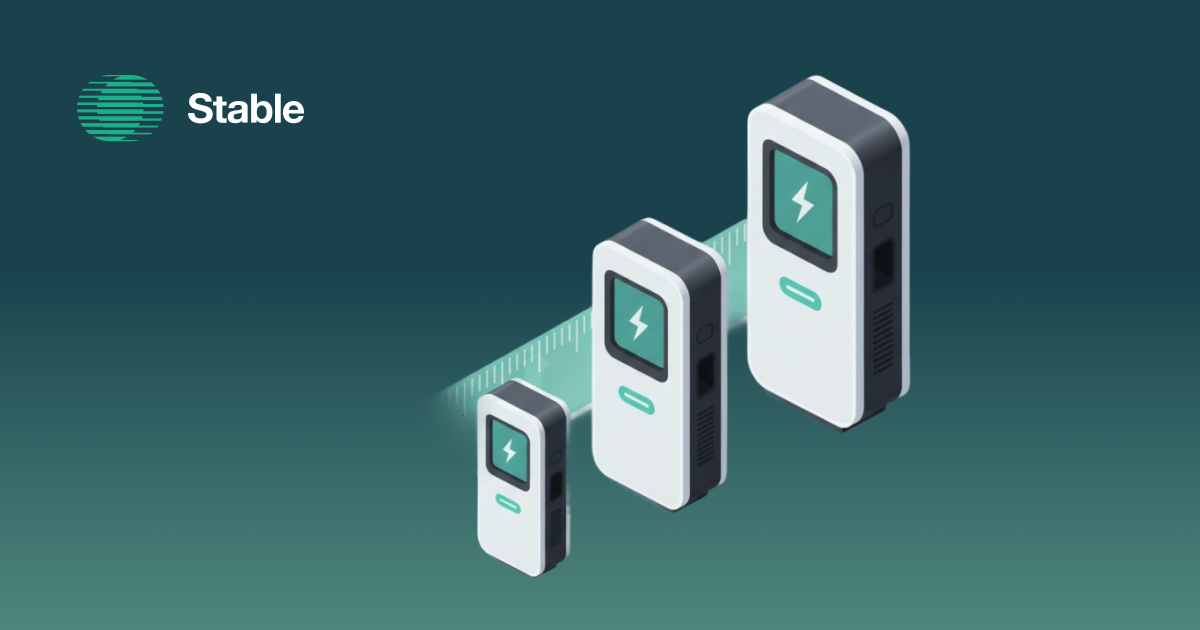
This is the fifth installment in a six-part series on designing and building profitable EV charging stations.
In the first four parts, we covered how to identify high-demand locations, forecast growth, model energy costs, and understand how incentives affect project economics. But even strong sites with solid fundamentals can fall short if the station is sized incorrectly.
Station sizing determines how you capture demand, how much capital you deploy, and ultimately how your returns scale. The difference often comes down to how charger count, power levels, and configuration interact with real-world demand.
Once you’ve done that work, the next step is turning it into a concrete station design.
You’ve identified a promising location, modeled growth trajectories, understood energy costs, and mapped available incentives. Now comes a decision that’ll lock in your capital requirements and shape your returns for years: how many chargers should you install, at what power levels, and in what configuration?
This isn’t something you can optimize with simple rules of thumb. Station sizing sits at the intersection of demand forecasting, energy economics, and hardware costs, and the interactions between these factors often produce counterintuitive results.
Three dimensions of station sizing
Station sizing involves three interconnected decisions, each with its own trade-offs:
- Number of chargers determines your station’s throughput capacity and affects both capital requirements and operating economics. More chargers mean more potential revenue, but also higher upfront costs and, critically, different demand dynamics than simply dividing existing traffic across more ports.
- Charger speed affects how quickly vehicles can charge and therefore how many sessions each port can handle. A 350 kW charger can theoretically serve more vehicles per hour than a 150 kW unit, but the hardware costs more, draws more power, and may not deliver proportionally more revenue if most vehicles can’t accept charge at those rates.
- Port configuration, specifically single versus dual-port chargers, creates another set of trade-offs. A dual-port charger typically costs more than a single-port unit but less than two separate single-port chargers. The economics depend on utilization patterns: if both ports are rarely used at the same time, you get flexibility at lower cost. If they frequently compete for power, you may create bottlenecks.
The counterintuitive dynamics of station size
One of the most common mistakes in station sizing is assuming that adding chargers simply divides existing demand across more ports. The reality is more complex, and more interesting.
Larger stations generate induced demand. Drivers who might’ve skipped a two-charger station due to crowding concerns will stop at an eight-charger station. Fleets that need reliable access for multiple vehicles at once will only consider stations above certain size thresholds. Ride-share drivers optimizing their routes factor in the probability of finding an available charger, and larger stations tend to win that calculation.
This means adding a charger doesn’t proportionally decrease usage at existing ports. A station that goes from four chargers to six won’t see each charger’s utilization drop by a third. Some portion of the new capacity serves drivers who wouldn’t have come at all. The induced demand effect varies by location, competitive landscape, and driver mix, but it’s real and material to the financial analysis.
This shows up at the portfolio level too. Adding four chargers to a high-utilization existing site might generate better returns than deploying those same four chargers at a new location, even accounting for diminishing marginal returns. The existing site has proven demand, lower customer acquisition costs, and benefits from induced demand. A new site starts from zero and carries execution risk.
Power availability and sharing strategies
Station sizing decisions are constrained, and sometimes shaped, by power availability. The utility’s ability to deliver power to your site, and the cost of the necessary infrastructure, can be the binding constraint on your configuration options.
Power sharing offers a way to optimize within these constraints. Rather than sizing your electrical infrastructure to handle every charger running at full capacity simultaneously, you can install lower total inverter capacity and share it dynamically across chargers.
Four 200 kW chargers don’t necessarily require 800 kW of infrastructure if they’re unlikely to all run at peak power at the same time.
You might deploy four 350 kW-capable chargers with 700 kW of total inverter capacity. When one vehicle is charging, it gets more of that capacity. When all ports are occupied, power is distributed based on each vehicle’s needs and acceptance rates. Since vehicles taper their charge rate as batteries fill, this approach often has minimal impact on the charging experience while reducing infrastructure costs.
The right power-sharing ratio depends on expected utilization patterns, the mix of vehicles you’ll serve, and your energy cost structure. It can help manage demand charges by capping your peak draw, but only if that cap aligns with your tariff and expected load profile.
Hardware costs and configuration trade-offs
Hardware costs don’t scale linearly with capacity or port count. A dual-port charger costs more than a single-port unit, but typically less than two separate single-port chargers of equivalent power. The savings come from shared electronics, housing, and installation labor.
This creates optimization opportunities. If your demand analysis suggests you need six charging ports, you might achieve that with six single-port chargers, three dual-port chargers, or some combination. The right answer depends on more than just hardware costs: how utilization distributes across ports, what the power-sharing implications are, and how maintenance and uptime differ between configurations.
Higher-power chargers command premium pricing but carry higher capital and energy costs. A 350 kW charger might cost significantly more than a 150 kW unit while only serving certain vehicle models at that full rate. If your location primarily serves vehicles that max out at lower speeds, the additional investment may not generate additional returns.
These trade-offs compound when you factor in energy costs. Higher-power chargers increase exposure to demand charges. A station with four 350 kW chargers has a potential peak demand of 1.4 MW, and even with power sharing, those demand charges can overwhelm the economics if utilization doesn’t justify it.
Balancing crowding, utilization, and returns
Station sizing ultimately comes down to balancing competing objectives. Higher utilization improves unit economics and spreads demand charges across more kWh, but excessive crowding drives customers away and caps your revenue potential.
More chargers reduce crowding and capture induced demand, but increase capital requirements and may push you into diminishing returns territory.
The optimal configuration depends on your target rate of return, your cost of capital, and your competitive position. A well-funded operator building market share might accept lower returns per charger in exchange for capturing more total demand. A capital-constrained developer might optimize for returns per dollar invested, even if that means leaving some demand unserved.
These aren’t decisions you can make with spreadsheet intuition. The interactions between demand dynamics, power configurations, hardware costs, and energy economics require modeling that captures how each factor affects the others.
Modeling configuration options
Stable’s Evaluate platform lets you test different station configurations against realistic demand forecasts and energy cost models.
You can compare scenarios: what happens to returns if you add two more chargers? How does power sharing at different ratios affect your demand charges and customer throughput? What’s the break-even point for upgrading from 150 kW to 350 kW chargers?
Because the platform integrates demand forecasting with tariff modeling and incentive calculations, you can see how configuration decisions ripple through your entire pro forma, not just the line items that seem directly affected. A power-sharing strategy that reduces demand charges might also affect your LCFS credit generation. An additional charger that seems marginally profitable on its own might push your total site economics past an incentive threshold.
For portfolio operators, this extends to cross-site decisions. Should your next four chargers go at Site A or Site B? Answering that requires comparing induced demand effects, energy cost structures, and marginal returns across locations. This analysis is only possible with integrated modeling.
The bottom line
Station sizing is where all the previous analysis, across demand, growth, energy costs, and incentives, comes together into concrete capital allocation decisions. The interactions are complex: more chargers can generate induced demand, but also higher costs; power sharing can reduce infrastructure requirements, but affects both customer experience and energy economics; dual-port configurations offer cost efficiencies, but come with utilization trade-offs.
The operators who get this right don’t rely on rules of thumb or industry averages. They model specific configurations against specific locations and understand how each choice affects every dimension of station economics.
What’s next
Station sizing determines how you capture demand, but the surrounding experience matters too. In Part 6, we’ll look at site amenities and how they affect dwell time, customer behavior, and overall performance.
Ready to test different station configurations?
Stable Evaluate lets you model how sizing decisions affect utilization, energy costs, and overall project returns.
Get started with Stable Evaluate for free
In this series:
Part 1: Choosing areas with the highest demand
Part 2: Forecasting growth
Part 3: Understanding energy costs
Part 4: Optimizing incentives
Part 5: Station sizing (this post)
Coming soon:
Part 6: Site amenities
Schedule a demo
Schedule a 30-min time-slot with us directly, or send us a message if there's something else we can help with.