
This is the third installment in a six-part series on designing and building profitable EV charging stations.
In the first two parts of this series, we explored how to identify high-demand locations and forecast how that demand evolves over time. But even perfect demand forecasting won’t save a station with an unfavorable energy cost structure. Energy costs are where many charging station business models succeed or fail, and the difference often comes down to understanding a single factor most operators don’t examine closely enough.
The two components of commercial electricity pricing
Commercial electricity bills have two distinct components that behave very differently as your station scales. Understanding both is essential to building an accurate financial model.
Consumption charges are what most people think of when they imagine electricity costs. You pay a rate per kilowatt-hour consumed. If your rate is $0.12/kWh and you deliver 10,000 kWh in a month, your consumption cost is $1,200. Simple and linear.
Demand charges are the hidden complexity. These are fees based on your peak power draw during a billing period, typically measured as the highest 15-minute average demand in kilowatts. If you have a 150 kW charger and it runs at full power even once during the month, you pay the demand charge for that entire 150 kW capacity, regardless of how little you actually used it.
This distinction matters enormously for charging stations because high-powered chargers create large demand charges even when they are mostly idle. A station that looks profitable on paper can quickly become unviable when demand charges are properly accounted for.
The math that changes everything
Consider a 150 kW DC fast charger with a typical commercial tariff: a $0.12/kWh consumption rate plus an $8/kW demand charge. The demand charge alone costs $1,200 per month (150 kW × $8/kW) before you deliver a single kilowatt-hour to customers.
At low utilization, these fixed demand costs can devastate your unit economics:
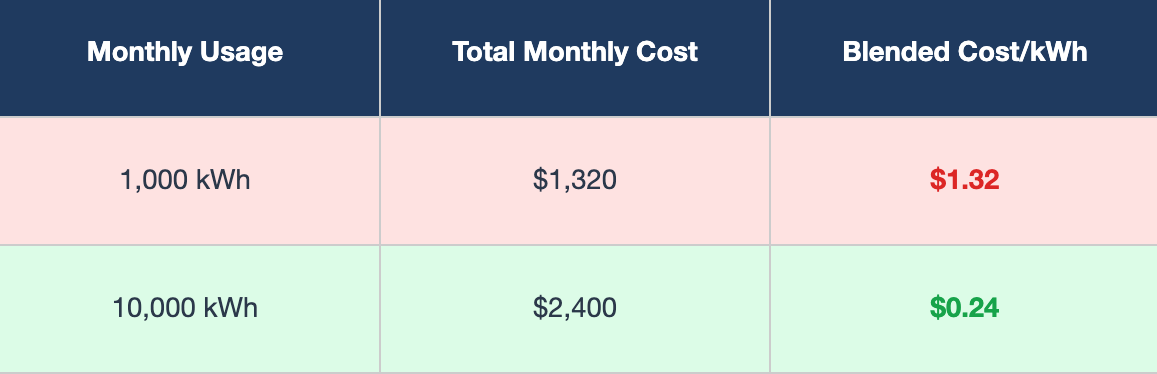
At 1,000 kWh per month, your blended electricity cost is $1.32/kWh, far above any realistic retail price point. Most operators can't break even selling power at $0.50/kWh, let alone cover equipment, maintenance, and land costs.
At 10,000 kWh per month, that same station’s blended cost drops to $0.24/kWh. Now there's margin to build a sustainable business. The consumption cost and demand charge haven't changed. Only utilization has.
This is why demand forecasting and energy cost modeling need to work together. A location with slightly lower demand but a favorable tariff structure may outperform a busier location with punishing demand charges.
The good news: special EV rates are emerging
Utilities across the country are recognizing that traditional commercial tariffs don’t work for EV charging’s unique load profile. The result is a growing patchwork of EV-specific rates that can dramatically improve station economics, if you know they exist and model them correctly.
These tariffs can offer much more attractive rates, but modeling them is often complicated. It's not as simple as just looking up the available consumption and demand rates, which is difficult enough on its own because they are often buried deep in regulatory filings. Each tariff can also come with its own quirks and conditions that you need to understand in order to estimate energy costs accurately.
PG&E’s commercial EV rates in California offer an attractive demand rate under the EV-2 tariff. But instead of simply paying for demand at the end of the month, you have to pre-pay for a block of demand in 50 kW increments. You need to predict your demand in advance and pay ahead for it, or you will face a demand charge that is nearly twice as high.
Con Edison’s EV Phase-In Rates in New York use a tiered structure based on load factor, the ratio of average demand to peak demand. Stations that maintain load factors above 25% qualify for significantly reduced demand charges. This creates a direct incentive for operators to optimize charging patterns and site selection for more consistent utilization rather than peak capacity.
National Grid’s EV Phase-In Rate in Massachusetts lists one demand rate, but then offers a rebate of up to 100% depending on the site’s load factor. This rebate phases out over time, and the demand rate itself is also based on the site’s load factor.
Eversource’s EV Rate Program in Connecticut offers an EV tariff that, like the Con Edison and National Grid programs, is tiered based on load factor. The Eversource tariff adds another layer of complexity because demand charges are billed in kVA and based on 30-minute increments.
Similar programs exist across dozens of utility territories, each with different eligibility requirements, rate structures, and application processes. The challenge is not just knowing these rates exist. It's modeling how each one affects your specific station economics under realistic usage scenarios.
Beyond simple rate comparison
The complexity goes well beyond choosing between two or three rate options. Modern EV tariffs incorporate multiple variables that interact in ways that are not always obvious.
Time-of-use pricing means consumption rates vary by hour. A station that sees heavy afternoon traffic pays very different rates than one serving early-morning commuters. The same total kWh delivered can have dramatically different costs depending on when it happens.
Seasonal rate structures shift economics throughout the year. Summer peak rates in many territories are significantly higher than winter rates, which affects annual profitability calculations.
Demand ratchets in some tariffs lock in your highest demand from recent months, meaning one unusual spike can affect bills for an entire season.
Subscription blocks and capacity reservations require committing to a certain level of demand capacity, which may or may not match your actual usage patterns.
Each of these factors needs to be modeled against your expected charging patterns, not just average utilization, but the hourly and seasonal distribution of that demand.
Modeling energy costs with confidence
Getting energy cost modeling right requires two capabilities that don’t naturally exist together: access to accurate, current tariff data across utility territories, and the ability to simulate how those tariffs interact with realistic charging demand patterns.
Stable’s Evaluate platform integrates both. We’ve partnered with Arcadia to maintain current rate schedules across major utility territories and model them using predicted 15-minute load intervals to deliver precise, location-specific energy cost forecasts. This means you can compare how different sites perform under their actual available tariffs, including EV-specific rates, rather than applying generic assumptions.
More importantly, you can model scenarios. What happens if utilization grows faster than expected? How does increasing charging speed affect station economics? How does the subscription model compare to traditional demand charges at different utilization levels?
These aren't hypothetical exercises. They're the core questions that determine whether a station generates returns or becomes a stranded asset.
The bottom line
Energy costs are where theoretical demand projections meet financial reality. A station can be perfectly located with strong forecasted demand and still fail if the electricity cost structure does not support the business model.
The operators and investors who succeed in EV charging understand that demand charges, not consumption rates, often determine the difference between profitable stations and money-losing ones. They know which utility programs can improve their economics and how to model the trade-offs between rate structures.
What's next
Energy costs are where demand projections meet financial reality. Even strong utilization can’t overcome an unfavorable tariff structure. In Part 4, we’ll explore another factor that can dramatically shift station economics: incentives. Federal, state, and utility programs can offset significant portions of capital and operating costs, but only if you identify them early and structure your project correctly.
Ready to model energy costs for your sites?
Stable Evaluate models real utility tariffs and demand charges so you can see how different locations perform under their actual energy cost structures before committing to a site.
Get started with Stable Evaluate for free
In this series:
Part 1: Choosing areas with the highest demand
Part 2: Forecasting growth
Part 3: Estimating energy costs (this post)
Coming soon:
Part 4: Optimizing available incentives
Part 5: Station sizing
Part 6: Amenities and perks
Schedule a demo
Schedule a 30-min time-slot with us directly, or send us a message if there's something else we can help with.